
Weather markets,
marked to model.
Six operational forecast models (ECMWF, NOAA, DWD, JMA, ECCC, and Météo-France) run against every live Polymarket temperature bracket. We convert the ensemble into a real probability distribution and show you, in cents, where the order book disagrees with the physics.
Includes an AI weather analyst that answers questions and explains the live board in plain English.
- Houston 88 to 89°FBUY NO −63.3mkt 96¢mdl 32%
- Wellington 16°CBUY YES +31.0mkt 2¢mdl 33%
- Los Angeles 66 to 67°FBUY NO −53.1mkt 87¢mdl 34%
- Shanghai 27°CBUY NO −32.6mkt 52¢mdl 19%
Ask the weather.
Understand the live board.
The PolyWeather bookmarklet launches an AI weather analyst on any Polymarket weather page. Ask a plain-English question about the forecast, or have it explain the live data shown across this site: market prices, six-model probabilities, model disagreement, settlement-station conditions, liquidity, edge, and risk. No browser extension required. Desktop only.
“Why does the market disagree with the forecast?”
I compare the current market price with the six-model probability, then explain model spread, station conditions, liquidity, and the risks that could change the outcome.
- Weather answers
- Temperature, rain, snow, and timing
- Live market data
- Price, probability, edge, and depth
- Evidence and risk
- Models, station, spread, and liquidity
Save it to your bookmarks bar
Drag the blue button to your desktop browser's bookmarks bar, not onto the page. Or copy the code and paste it into a bookmark's URL field, keeping the
javascript:prefix.Bar hidden? In Chrome, Edge, Brave, or Firefox, use Ctrl + Shift + B on Windows/Linux.
Open a weather market
Go to Polymarket in the same desktop browser and open the weather market you want to view. Keep that market page active.
Open the AI weather analyst
Click Activate PolyWeather to launch the AI on the market page. Ask about the forecast or have it explain any live PolyWeather metric, including price, model probability, edge, spread, station conditions, liquidity, and risk.
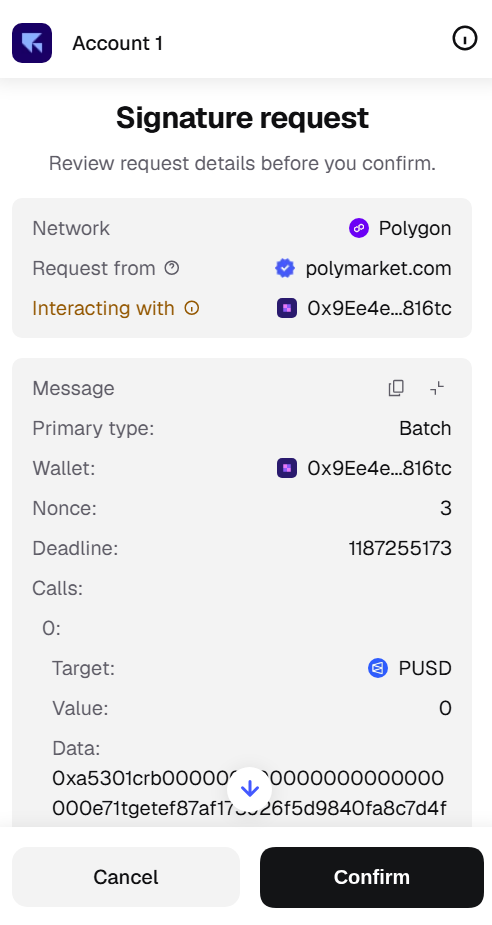
If a signature request to verify appears before you use the bookmarklet, your wallet may show a screen similar to the example pictured here. This image shows how that request could appear, although the exact wording, details, and layout may vary depending on the wallet you use.
The edge board
Every open temperature bracket, ranked by how far the market price sits from the ensemble probability. Conviction weights the gap by how much size the book can actually absorb.
The whole ladder, city by city
A single bracket price tells you nothing on its own. Here is the full bracket ladder next to the ensemble distribution, plus each model's raw run for the settlement day.
Paris high on Oct 12
Now 15.3°C · Overcast · wind 12 km/h
- ECMWF IFS 0.2518.5°
- NOAA GFS19.6°
- DWD ICON19.5°
- JMA GSM/MSM17.9°
- ECCC GEM20.2°
- Meteo-France ARPEGE20.2°
- 14°C or below0¢0%0.0
- 15°C0¢0%+0.1
- 16°C0¢1%+1.3
- 17°C0¢7%+6.6
- 18°C0¢18%+18.3
- 19°C0¢29%+29.0
- 20°C100¢26%−73.5
- 21°C0¢13%+13.2
- 22°C0¢4%+3.9
- 23°C0¢1%+0.6
- 24°C or higher0¢0%0.0
No black box. Four steps.
- 01
Pull the book
Every open Polymarket weather event, every temperature bracket: mid price, 24-hour drift and resting liquidity, straight from the Gamma API.
- 02
Run the ensemble
Six operational forecast models are queried for daily maximum temperature at the exact station coordinates the market settles on.
- 03
Fit the distribution
Inter-model spread becomes σ, widened for model-to-station bias and intra-day timing error, then integrated across each bracket's edges.
- 04
Rank the disagreement
Edge is model probability minus market price. Conviction discounts that edge by how much size the order book can actually absorb.
- ECMWFIFS 0.25Global · 0.25° · best-in-class medium range
- NOAAGFSGlobal + HRRR nest over CONUS
- DWDICONGlobal 13km + ICON-D2 2km nest
- JMAGSM/MSMGSM global + MSM 5km over Japan
- ECCCGEMGEM global + HRDPS 2.5km over Canada
- Meteo-FranceARPEGEARPEGE + AROME 1.5km over Europe
Ensemble spread understates true uncertainty on convective days, and the official settlement station can run warmer or cooler than the model grid cell. We floor σ at 1.5°F to avoid overconfident tails: a narrow-spread bracket showing huge edge is usually σ being too optimistic, not free money.
- Mean live spread (norm. °F)
- 1.67°F
- Resting liquidity
- $1,115,414
- Refresh cadence
- 15 min
Wherever the book is open
Coverage follows Polymarket. New city listed overnight, and it appears here on the next refresh with its settlement station already wired to the ensemble.
Questions a trader would ask
What is the PolyWeather AI bookmarklet?
It is an AI weather analyst saved as a desktop browser bookmark rather than a browser extension. Click it while a Polymarket weather page is open to ask forecast questions and get plain-English explanations of the live weather, model, market, station, liquidity, edge, and risk data shown across PolyWeather. It is desktop-only and cannot be used on mobile.
What can I ask the AI weather analyst?
Ask direct weather questions such as whether it will rain, snow, or clear a temperature threshold. You can also ask why a market price differs from the six-model forecast, which models disagree, what the settlement station is reporting, how strong the edge is, or which uncertainty and liquidity risks matter. Answers use the current market and weather context rather than generic definitions alone.
How do I install or update the bookmarklet?
On your computer, choose Get bookmarklet, then drag Activate PolyWeather to your bookmarks bar. You can also copy the original code and paste it into the URL field of a new bookmark. To update an existing bookmark, replace its entire URL with that code, including the javascript: prefix.
Why is the bookmarklet not opening?
Use a desktop browser with a Polymarket weather page open, not a browser settings page, a new tab, or an in-app browser. The tool is not supported on mobile. Check that the bookmark's URL contains the complete code and starts with javascript:. Some browsers or site security policies block bookmarklets. Do not disable your browser's security protections; try another desktop browser instead.
What exactly is the edge number?
Ensemble probability minus the market's YES price, in percentage points. A bracket trading at 26¢ that the ensemble puts at 41% shows +15.0 where the market is underpricing it by fifteen points. Negative edge means the opposite side is the value.
Why weight by liquidity?
A 40-point edge on a book with $200 resting is noise; a 6-point edge on a $30,000 book is a trade. Conviction multiplies the raw edge by how much of the book can absorb size, so the ranking is not dominated by dead brackets.
Is a single deterministic run per model enough?
It is a control-run ensemble, not a full 51-member EPS. Inter-model disagreement captures most of the day-one and day-two uncertainty for daily maximum temperature, which is where these markets live. We floor σ at 1.5°F so the tails stay honest.
Do you account for the settlement station?
We query the ensemble at the coordinates of the station each market settles on, so the grid cell is right. What we cannot fully remove is the station's own microclimate bias against that cell, which is one of the reasons σ is widened rather than taken raw.
How fresh is the data?
Market prices and model runs are both revalidated every fifteen minutes. Global models publish four cycles a day, so the ensemble mean typically steps rather than drifts, while the book moves continuously.
Is this trading advice?
No. It is a pricing tool. It shows where a physics-based forecast disagrees with a prediction market and nothing more. Prediction markets carry real risk of loss and are restricted in some jurisdictions.